
Housing in Quito is less expensive than in the U.S.
By now we might have paid off the old house, but for a number of reasons we had refinanced often. New siding and windows and a fresher kitchen were essential before we could put the house on the market, and in 2020 we went ahead with a 15-year mortgage at the low, low rate of 3.25 percent.
That meant our mortgage payment was $2,200 a month, or too much for our retirement budget. We might have swung it if I’d begun receiving Social Security, but in hopeful naivete I am waiting until I hit my full retirement age in 2027. We cleared some cash on the house and determined to invest most of it and use the rest for the expense of restarting in a new country and domicile.
I am aware of how much privilege the last two paragraphs represent. How were we even able to have a house on our very middle class income, much less one with a huge lot on a lake in a quiet neighborhood four houses from Minneapolis?
One answer is that Bill’s parents did well for themselves financially and left him money that helped subsidize our work income. This, along with financial aid, made it possible for us not only to stay in our house but also to send Charlie to schools where he was able to thrive. They were not public schools.
Our choices in this, combined with my career-concluding 11 years in public K-12 education, could make for their own post — but they won’t. In any case, we have zero regrets about having made those choices, even though Bill and I might be embarking on a somewhat different retirement if a substantial portion of his inherited wealth hadn’t been used for Charlie’s education from third grade forward.
Once you see it, it’s so clear: the cycle of privilege for people who have more than enough, enough in fact to save and invest; the luck to inherit or ability to purchase assets that accrue in value; the wherewithal to seek out and receive admission to schools that encourage individualism and imagination and independent thought rather than schools that insist on the opposite . . . it goes on and on. You can’t unsee it. Do we deserve it? Did we earn the privilege we enjoy? These are questions I have pondered since I was a child, wondering why some people have so much while others had so little.
Anyhoo.
Staying in the house was not possible. Apartments in Minneapolis cost upwards of $1,500/month and well more than that if you want enough space to occasionally get away from your spouse. We rented storage for Charlie’s things, sold one car and gave away the other, and dispatched the rest of our material possessions, including hundreds of books and CDs, to family and friends, charity, or our local Buy Nothing group. We would travel as lightly as we could (along with the bicycles, ahem) and rent a furnished apartment in Ecuador. Just where in Ecuador we didn’t yet know.
Our gurus JP and Amelia did a video on life in the Quito suburb of Cumbayá, which in addition to having a funny name seemed like it might be a good transitional area after the U.S. We even hired JP and Amelia’s driver Xavier, a lovely man, to take us there and drive us around. For whatever reason, perhaps including the line of people waiting to get into the mall before it opened at 10 a.m., we didn’t like it. It felt like an unwalkable American suburb, and it was filled with gated communities called urbanizaciones. We had planned not to buy a car, and we didn’t want to be so far from the city action. Xavier advised us to look for a place close to Parque Carolina, an enormous green space in the center of the affluent business-oriented area of Quito.
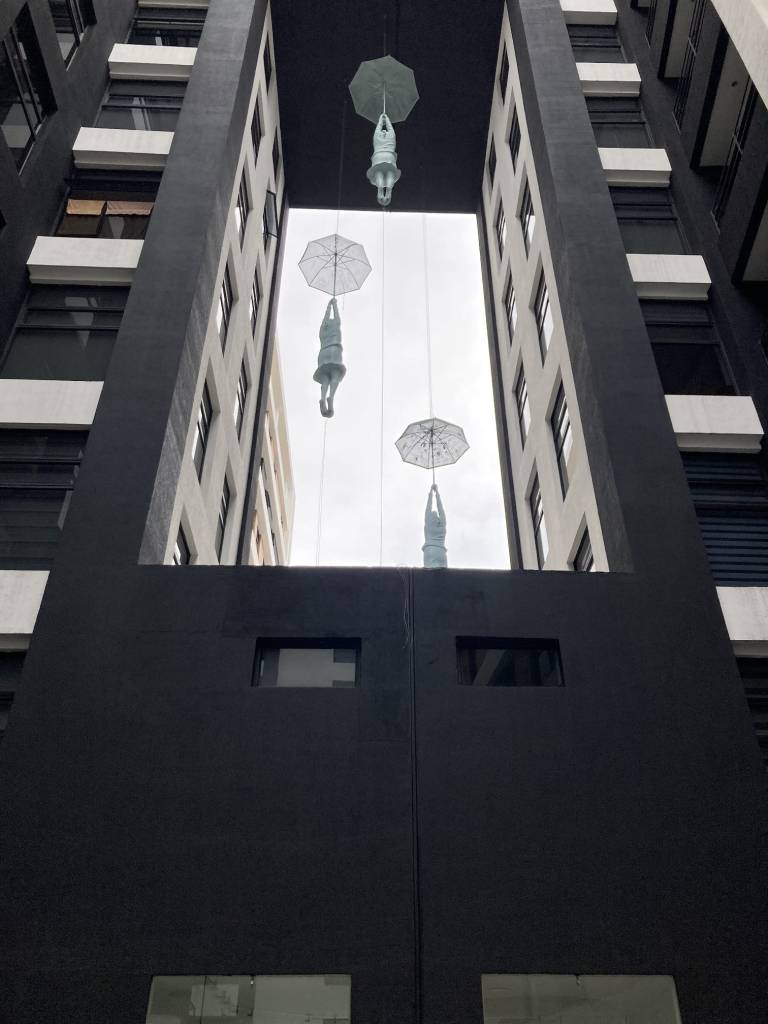
Our first accommodation this spring was an Airbnb that cost about $1,300 for six weeks. It was a one-bedroom apartment in a high rise (see its public art above) with loads of amenities: a pool, separate spa areas for men and women, a movie theater, a kids’ play area, and phenomenal water pressure. Apartments rented in the building for $600/month. But, close as it was to Parque Carolina, it was on one of the busiest streets in the whole huge city, with traffic noise at all hours — in their defense, Quito drivers do usually wait for the light to turn green before they start honking at the drivers in front of them — and no birdsong. We suffered through occasional all-night parties, thudding bass beats and karaoke, and the raised voices of our next-door neighbors.
Individuals, not management companies, seem to own most of the apartments for rent in Quito. Owners hire a real estate agent to advertise their apartments, which are mostly unfurnished. We never found just one agent who would serve as advocate and help us find an apartment that met our needs; we instead found many agents representing specific properties.
We looked on Facebook Marketplace and real estate sites for places that met our specs — furnished two-bedroom units and green space were our main requirements — but getting return messages was tough, and not sharing a common language with most of the representatives didn’t help. I reluctantly used Google Translate and common sense to proofread property descriptions and send inquiries to agents.
The first apartment we looked at belonged to a young man heading off to grad school. It was on the 16th floor, had two bedrooms and an office-y alcove and a common entertainment area on the roof. He and his English-speaking agents were asking $1,200 a month, too high for our budget. Also, it was just plain too high; I wasn’t keen on being on the 16th floor. Something about earthquakes.
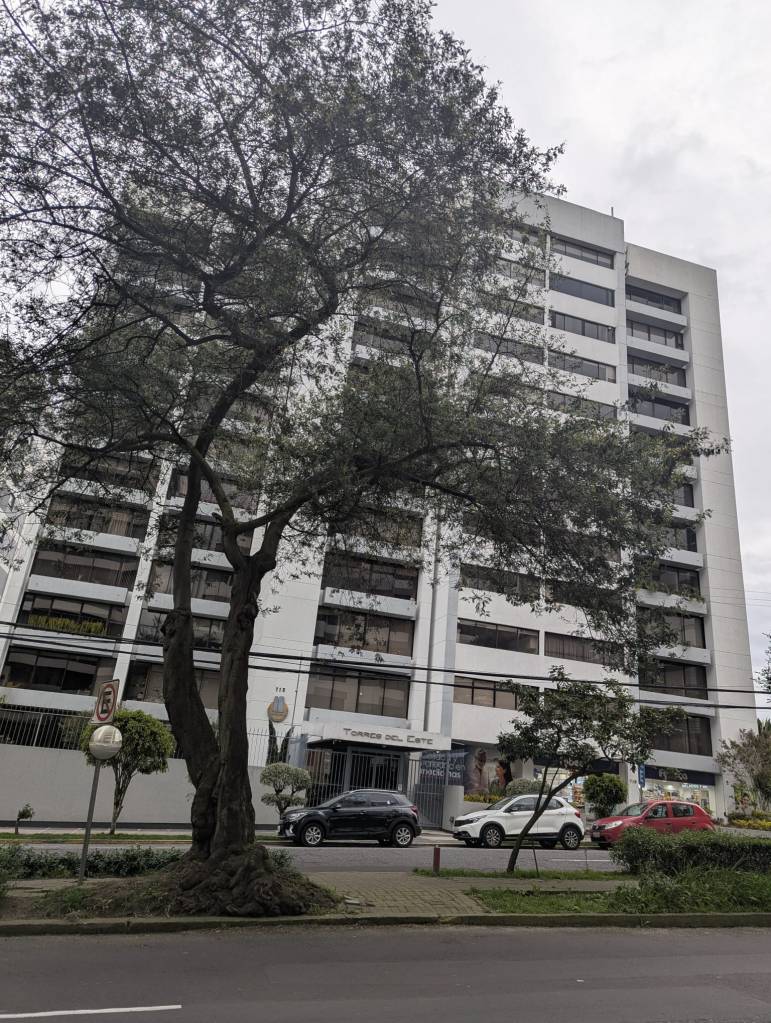
The next apartment (see building below) was in an area called Gonzales Suarez, filled with multistory apartment buildings. The owner was an older woman with many nice things that seemed, in fact, way too nice for us. I thought I smelled mildew, which the agent disavowed. One thing I loved about the neighborhood was the glut of coffee shops and bakeries.
Two main styles seem to dominate decor in Quito: (1) heavy and formal and brown, sort of neo-colonial; and (2) sleek, modern, and colorless. In the largely residential Quito Tenis neighborhood we toured an apartment that was entirely gray and white with some splashes of black. If the second apartment seemed too formal for us, this one was off-the-charts too sleek, and still occupied by people who kept it spotless.
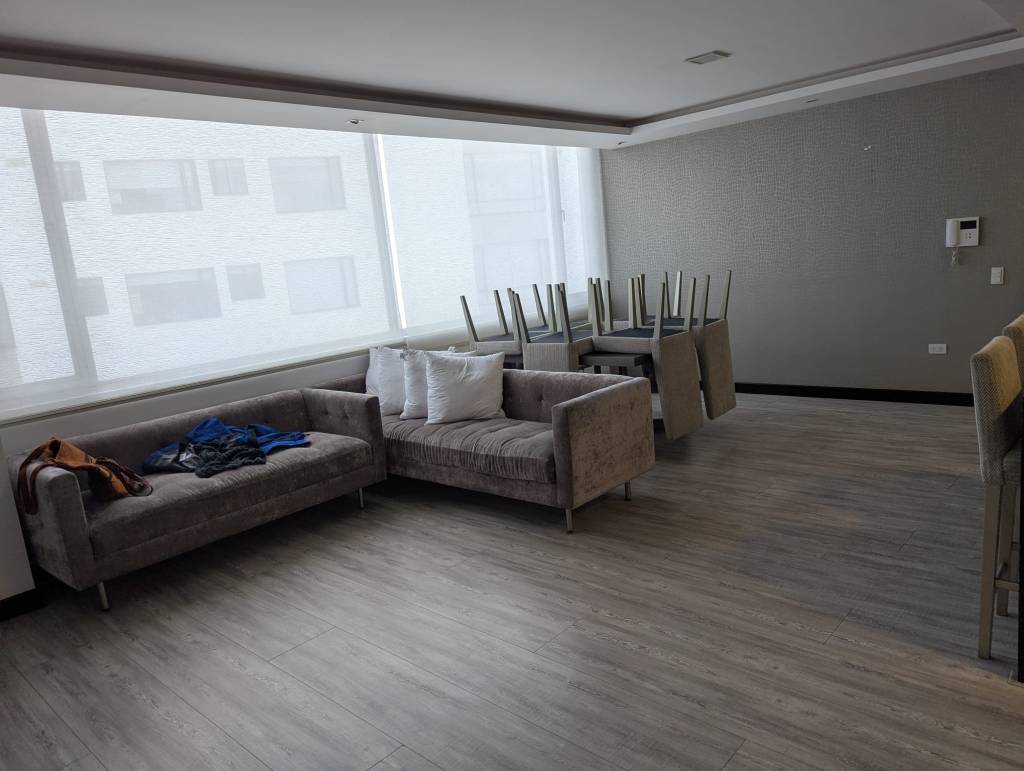
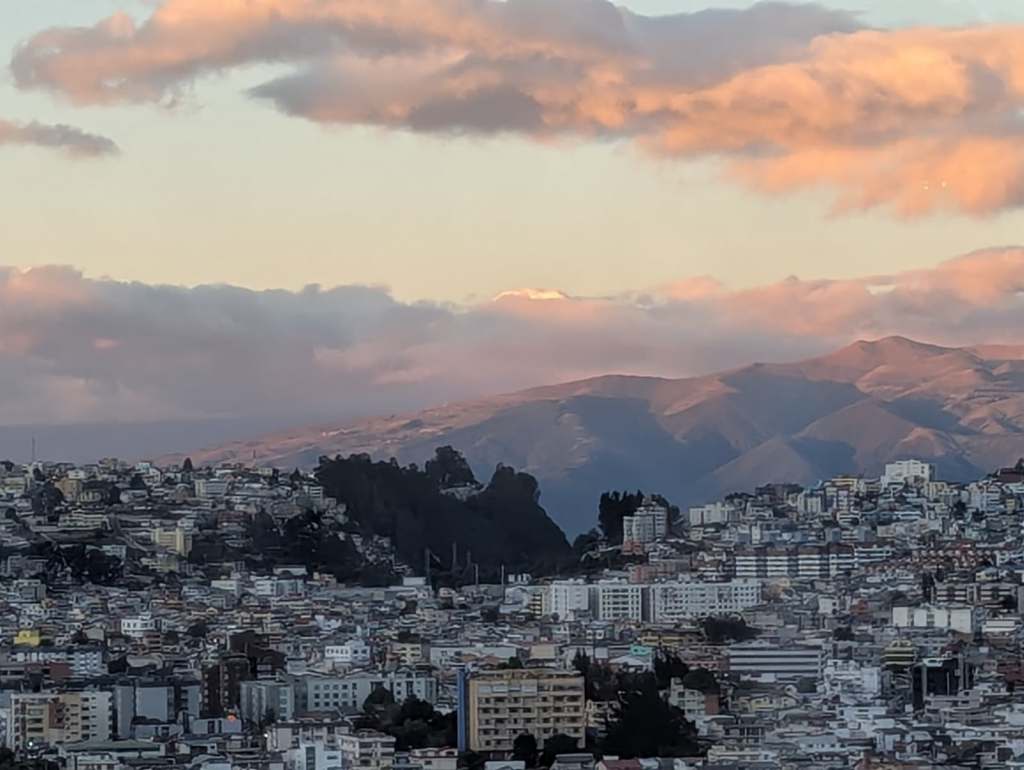
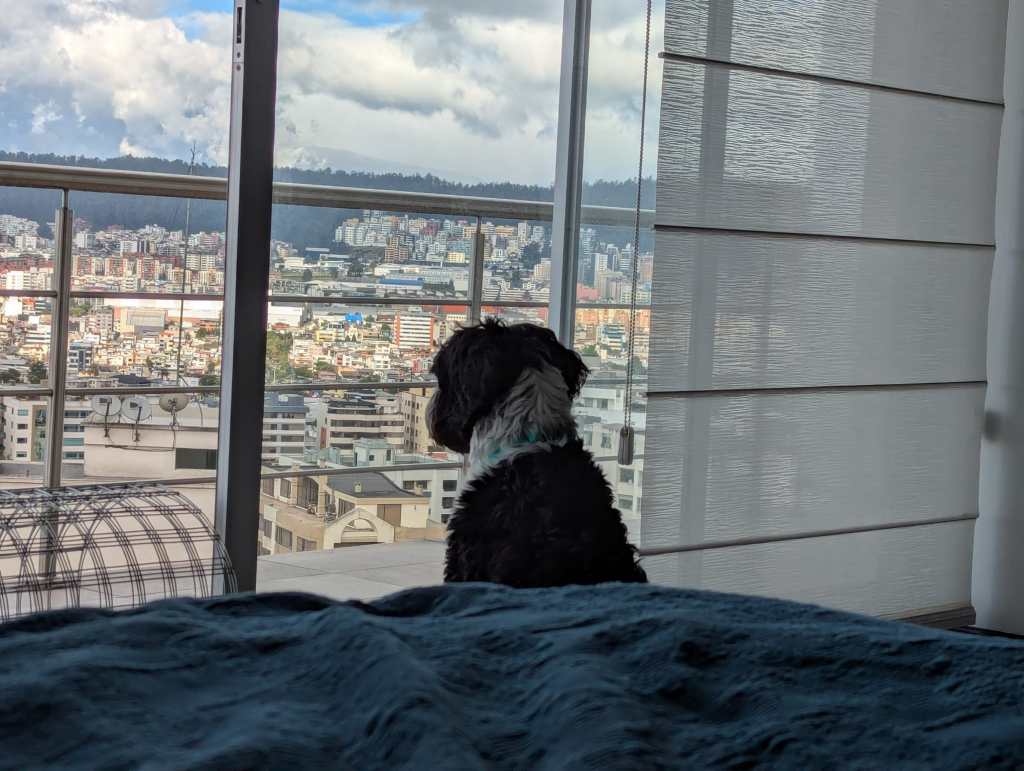
It had elegant and modern gray furnishings, two bedrooms each with its own bath, and a half bath — known here as a “social bathroom,” so visitors needn’t be exposed to the sight of your grubby toothbrush or questionable ointments — and a balcony off the main bedroom with a 180-degree view of Quito. That view includes, on a clear day, Cayambe volcano (its snow-capped peak barely visible in photo below).
The owner and his rental agent both spoke English better than we will ever speak Spanish. They took us through the apartment and the common spaces on the roof, featuring two separate areas with artificial turf where the dog might frolic if we were unable to walk her at any of the three nearby parks. They praised the area for its safety and relative quiet, along with its proximity to nearly everything we could need. The rent was $1,200.
We asked the agent to show us other properties, which she did. One was furnished more nearly in our preferred boho style but hemmed in on all sides by other tall buildings. The other was back in Gonzales Suarez but unfurnished. Renting furniture is not generally done here, and after giving away all the furniture I’d spent four decades acquiring, I wasn’t about to purchase another houseful.
We offered $1,000/month for the Quito Tenis unit and have lived here since the middle of May. In addition to the rent we pay $154 monthly in alícuota, essentially association fees. Included in our rent is water. We pay $30/month for electricity — no AC or heat is needed in Quito — and about $27/month for internet. Our Ecuadorian cell phone service is about $30/month for two lines.
We’ve spent a few hundred dollars on household items with color: a chair and rug, some machine-woven striped throws with bright traditional motifs and colors, two wool wall hangings, and touristy items like masks and bowls.
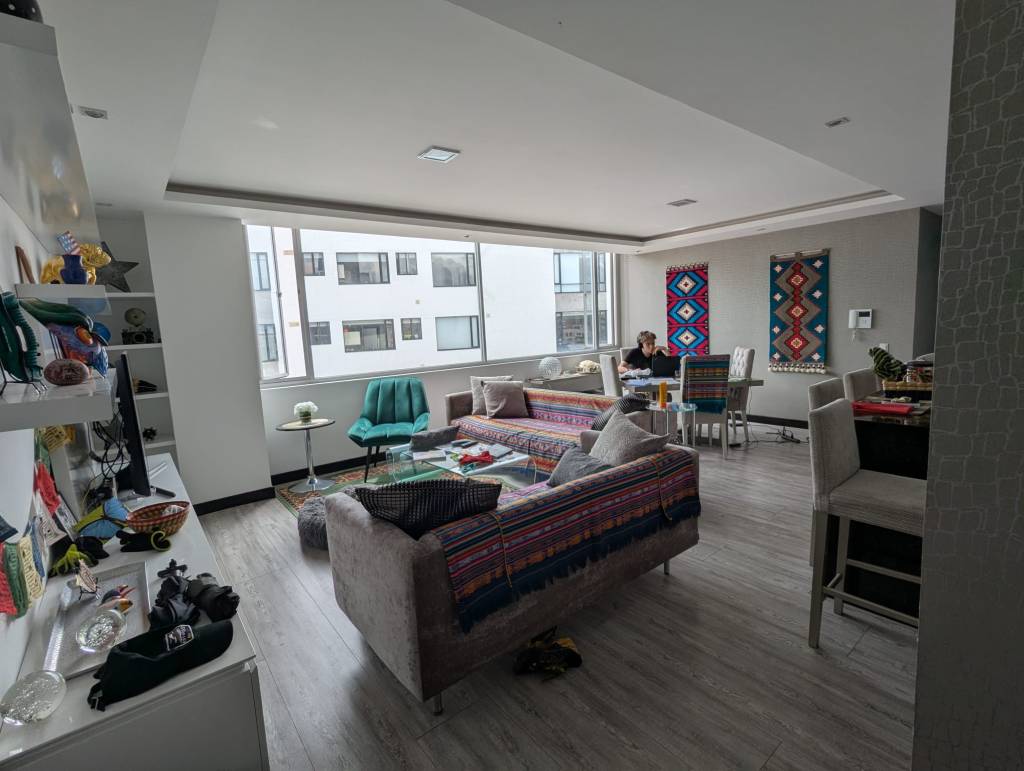
The water pressure is poor and the drains sluggish, the places we need to walk are uphill both ways, and there’s a funky smell whose origin is the laundry room — we have a washer and dryer too. But I’ll be damned if it hasn’t started to feel like home.


Leave a Reply