
Yesterday we got into an Uber and there, in the back seat, was the driver’s son. Four years old, neither sitting in a car seat nor wearing a seat belt. Just a gorgeous, silent little boy riding along with no protection from the insane Quito traffic apart from the car itself. When we arrived at our destination, the kid shyly offered Bill a high five.
We have seen toddlers without helmets sitting on the laps of people riding motorcycles, and we have seen babies being held by parents in the front seats of moving cars. We have not seen news stories about children dying in road accidents because they weren’t strapped into car seats. I’m sure it happens, but we’ve not seen it on the news.
What we do see on the tv news – we watch TeleAmazonas (TA) via YouTube – is a lot of murder, kidnapping and crime. If it bleeds it leads, in Ecuador as well as in the U.S., and there’s a lot of bloodshed in parts of this country.

The morning team of Andrea and Juan Miguel, both attractive and well dressed young people, is relentlessly cheerful for the first three minutes of every weekday broadcast. We see drone footage of the sun coming up over the Andes, and Andrea typically offers virtual abrazos, or hugs, to her viewers before diving into the uniformly horrific news. Gustavo is their man on the street, who reports live from a series of locations around the center of town.
TA has run several stories on the back-to-school shopping that kicked into high gear only this last week. School starts here on Sept. 1. In previous years, with different leaders, apparently the government helped assure students had the school supplies and books they needed. Now it’s up to families to pay for their supplies. It’s a boon for papelerías and a pain point for the many families who don’t have $60 (on average) per student to spend on uniforms and other necessities.
Keep in mind that I don’t understand much of the news and do a lot of extrapolating from the video and the few words I grasp. A news story we have not seen here is mass shootings of children by strangers.
At the mall
Shopping malls are everywhere in Quito. We have been to four or five, and they are never not hopping. The food courts in particular are thronged at every hour, and the available cuisines range from fast food – burgers, deli sandwiches and the hugely popular KFC (pronounced kah effa SAY) – to ceviche to fancy sit-down restaurants (photo below is of a ceviche roll from Noe, a sushi restaurant). Oh, and Starbucks, which arrived in Ecuador only recently and is always busy.

Food courts are a great spot to watch people. At lunch on the last Saturday of the summer, we observed hundreds of Quiteños, mostly families out together. We were in El Jardín, a mall that we’ve heard is more staid and therefore less popular among young people, so there were no clots of teenagers.
It’s common to see multiple generations out together, the adults often walking arm-in-arm with their elderly parents, teen or tween children, or even their same-sex friends. They all seem to get along. They talk to each other.
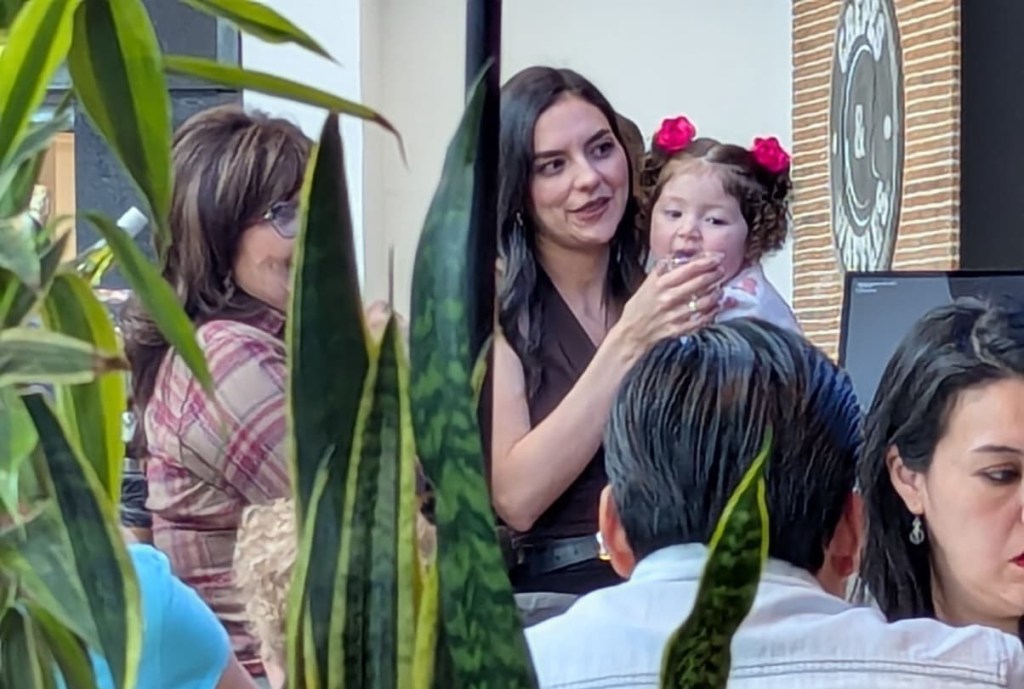
After years of shopping online and going to an actual mall only to return the occasional purchase, I am still astounded to see so many people doing so much in the malls here. I’m unsure how much they actually buy, other than a meal or snack, but malls in Quito seem to be indoor town squares where folks gather to hang out and enjoy each other’s company.
Maybe malls were like this at one time in the U.S. I have faded memories of Chris-Town Mall in the 1960s (“Legions of Phoenix natives can still recall the legendary organ grinder and his passive-aggressive monkey”), with its two-story cages of live parakeets, being a busy and exciting place.
In Quito nobody walks around – anywhere, in a mall or on the street – with soda cans or coffee drinks. We do see a surprising number of folks, including business people on weekdays, walking around with ice cream on a stick or in a cone.
In our latest mall foray we had three options for buying ice cream within 50 paces of the entrance – and I’m sure there were more. We skipped the frozen offerings from the Cinnabon kiosk; we passed up the ice cream counter at Crepes & Waffles, a popular sit-down restaurant chain. Instead we bought our rich, heavenly scoops, served in dipped cones garnished with a small lozenge of dark chocolate, at Republica del Cacao.
The second thought
After writing about the excellent medical care I received after my recent accident, I realized I sounded like the classic “expat” – a term we try to not to use about ourselves. “Expat” smells of privilege, of people who could go anywhere but who have gifted this place with their presence and cash, and oh how smart they are to be getting so much more for so much less.
Within a few days of my experience in the Axxis Hospital ER, our friends at TeleAmazonas ran a news story about how organized crime controls public hospitals in parts of Ecuador. The buildings are in foul disrepair, medicines in short supply (although you can sometimes buy them from tents on the sidewalk); medical personnel struggle to provide even basic services, and some patients are desperate for care they have little hope of getting.
But hey, I received splendid treatment in the private Axxis Hospital and paid my bills with a credit card. It’s great to be an expat!


 Report from Quito
Leave a reply to Connie Cancel reply