
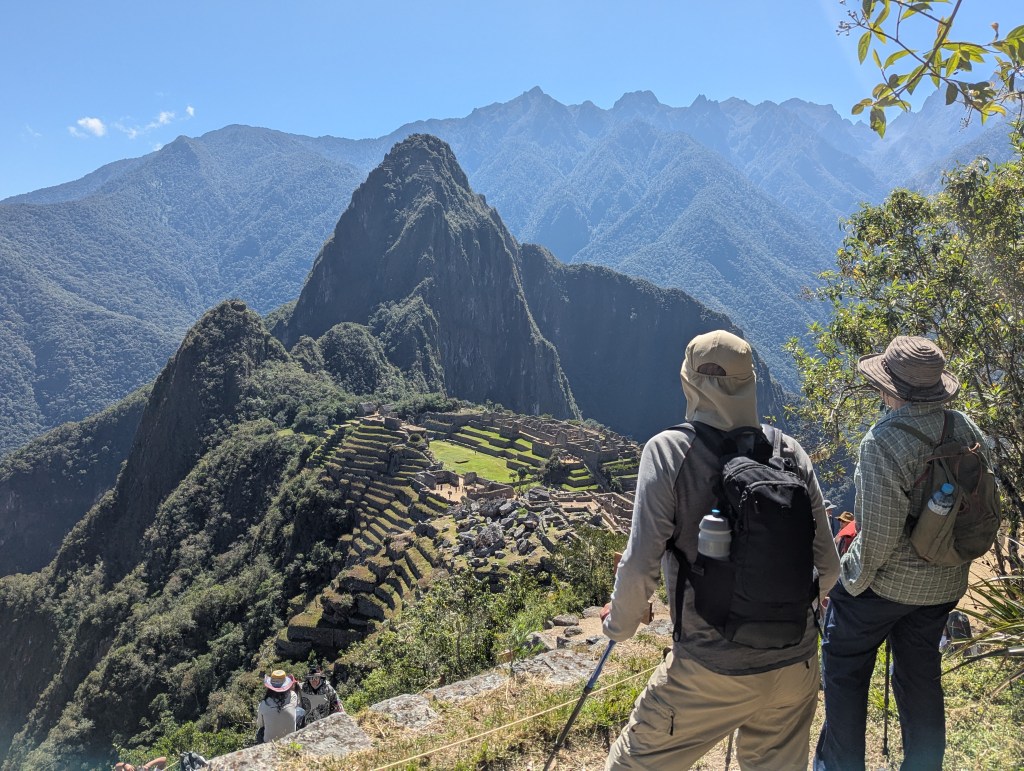
We went to Peru last month, on a 10-day tour with Overseas Adventure Travel (OAT), a company that specializes in tours for people over 50. The average age is reportedly 72.
The trip’s price had been marked down significantly and, we thought, we’re a short hop by plane to Peru, so why not? We booked extra time in Lima before and after the tour, and it was an eye opener.
On the Pacific coast, the city is 9,350 feet lower than where we live in Quito. In Moby Dick, Melville calls it “white, tearless Lima,” and indeed it was humidly overcast with fog nearly every day we were there, although it did squeeze out a few tears one morning. Much of Peru is desert. Leaving the airport upon our arrival, I was amazed to be reminded of Phoenix.
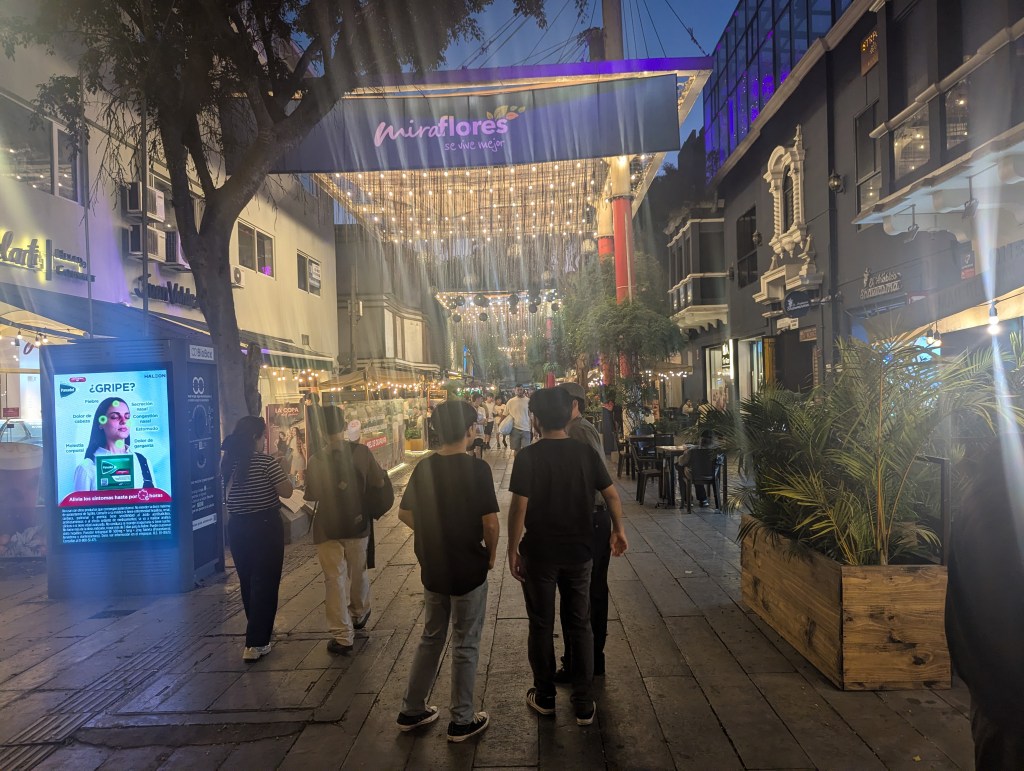
Saturday night in Lima. People are less fearful here than in Quito, perhaps because there is less to fear.
Lima feels far more sophisticated than Quito. At least in the tourist areas, it’s cleaner, and the streetscape is significantly more attractive. The long heritage of Asian migration to Peru makes for a more visibly diverse cast to the population, to which the glut of tourists from all over contributes. The infrastructure, at least as evidenced by sidewalks (again, we were in affluent parts of town), is miles ahead of where we live. Not only can you walk without keeping your eyes glued to the ground, you can observe people in wheelchairs getting around easily. Who knew curb cuts could be such a refreshing sight?
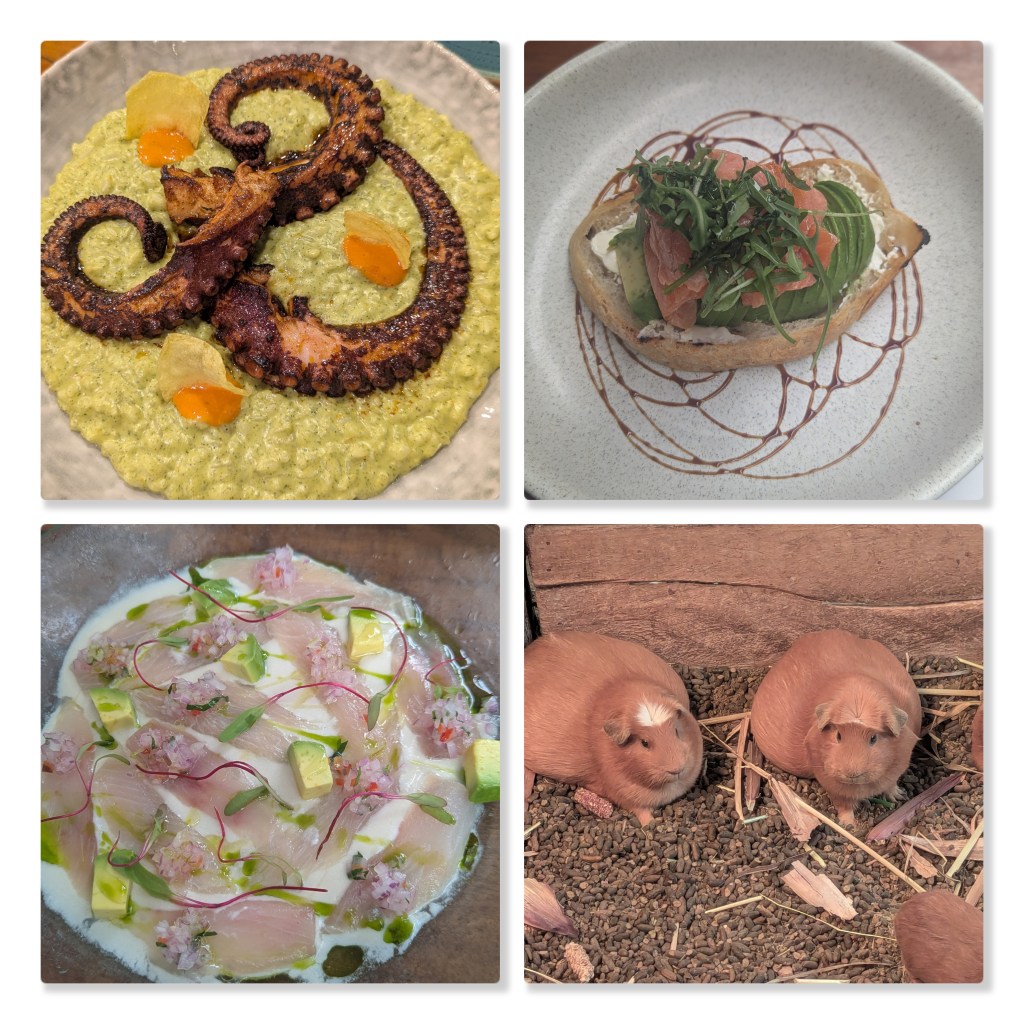
Three restaurant meals and (pregnant) cuy on the hoof.
The city is world famous for its cuisine – which also benefits greatly from diversity – and we had some really delicious food. The service standards are uniformly high too. Bill’s sister Stacy lived in Lima for several years and advised us where to eat and shop, including Delifrance, filled with imported cheeses and many other goodies we can only dream about in Ecuador.
The night before our tour began we went to Huaca Pucllana, a huge pre-Inca ruin in the middle of town that also houses a restaurant. One wall is open wide to the ruin, and in the early evening the room was dim, the better to appreciate the mood lighting on the excavations. Our arrogant waiter was visibly annoyed because we wanted to retain our menu through the first course, a scallop appetizer. I was hungry and dove into the scallops, each tiny round glopped with melted cheese and served in its own shell on a bed of frizzled seaweed. When the scallops were eaten I checked out the garnish, thinking I spied some foam – molecular gastronomy, don’t you know – and took a bite.
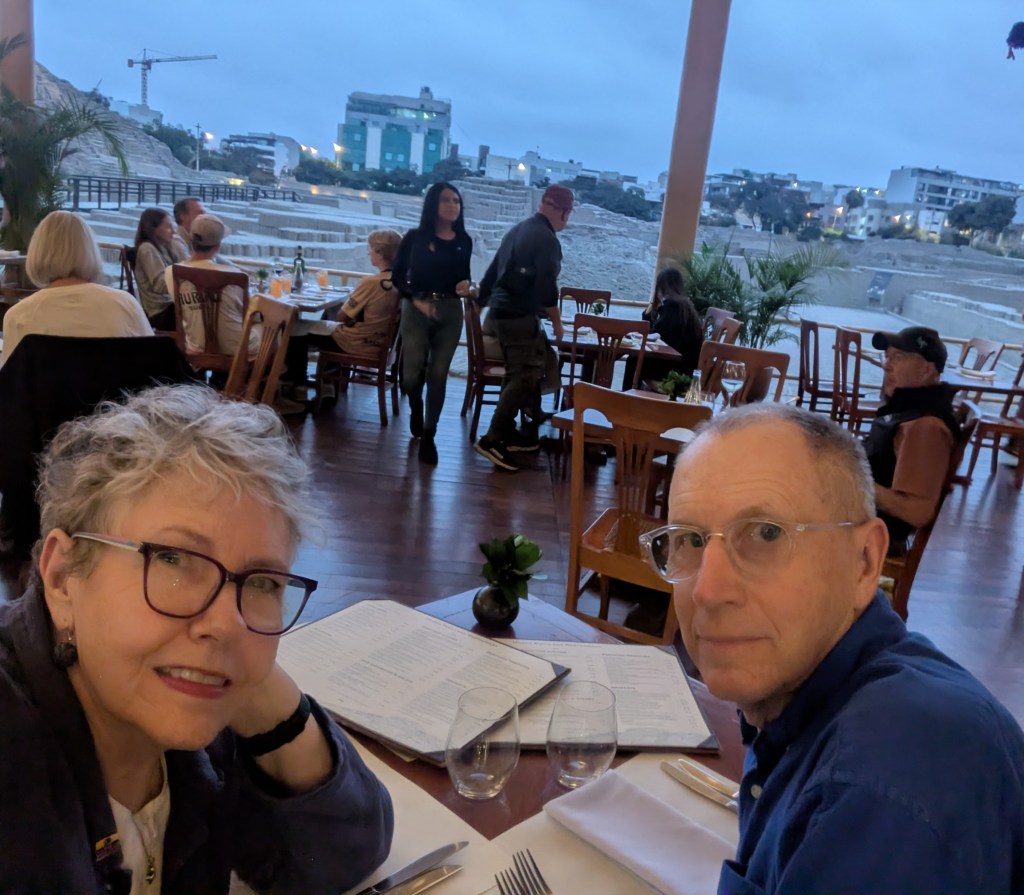
Avant le déluge
It was nothing but salt, coarse and damp and formed into a plinth for the scallop shell, and I had to swallow it because there was nothing else to do. Except wait. Because a few minutes later, I had to excuse myself hurriedly to find the bathroom and barf up everything in my stomach. If you ever need to throw up, eat a spoonful of salt.
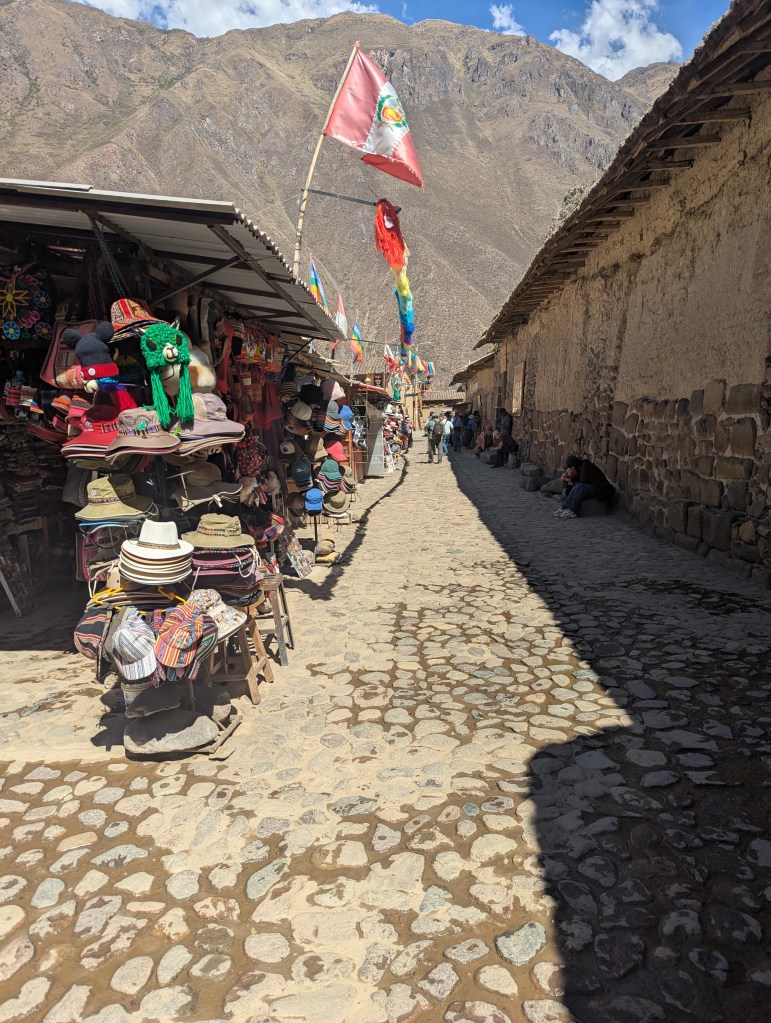
Market in Ollantaytambo, once an Incan community built on the foundations of previous cultures.
The places where we ate on the tour were a little less fascinating (and less nauseating) than Huaca Pucllana. I had dreaded sitting in a Peruvian restaurant at a table of 16 Americans, but our fellow travelers were pretty nice people and it wasn’t terrible. Sometimes we had a glass of wine or beer; sometimes there was live music: a guy who played many sizes of Andean flute with recorded accompaniment; a guy who played an Andean harp. Once we ate in a cavernous restaurant with an enormous buffet, designed for the tourist bus crowd. Here I sampled cuy [kwee] – guinea pig – for the first time. Not much meat there, and what there is is gnarly.
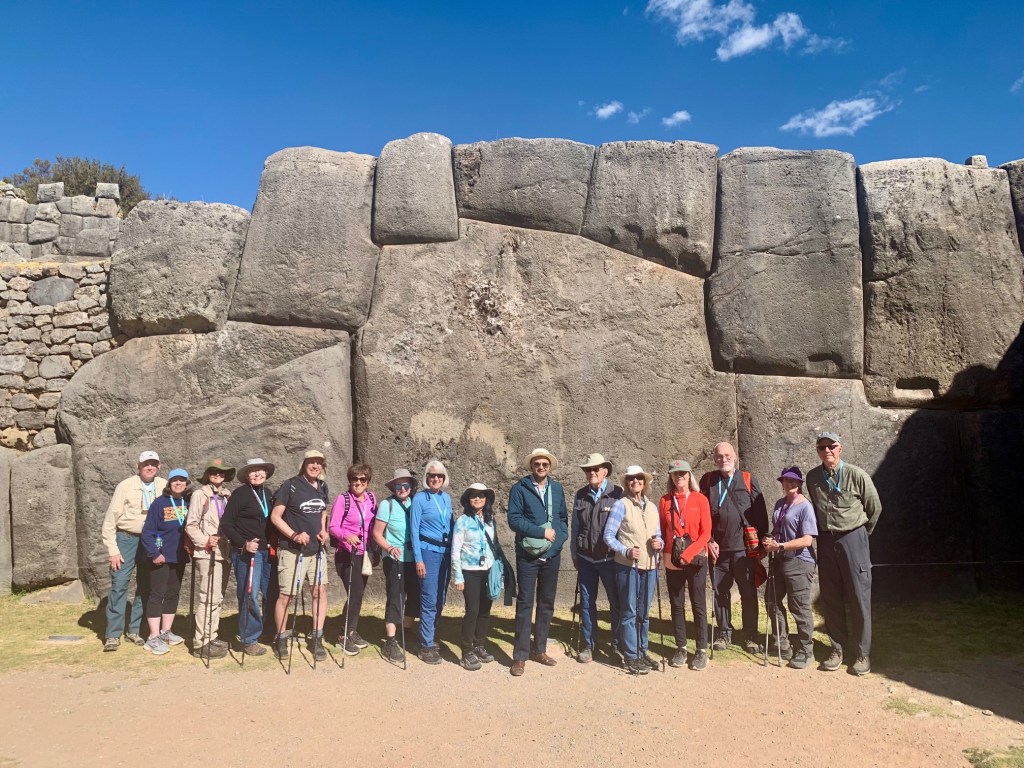
The tour was neither relaxing nor a vacation, but it was the way to check boxes on a list we didn’t know we had. One, two, three, four, five different Inca ruins, including of course Machu Picchu (pronounced not PEAchoo but PEAKchoo by those in the know) – which I’m truly glad we were able to manage. If this site is on your list, don’t wait. Trekking poles are useful.
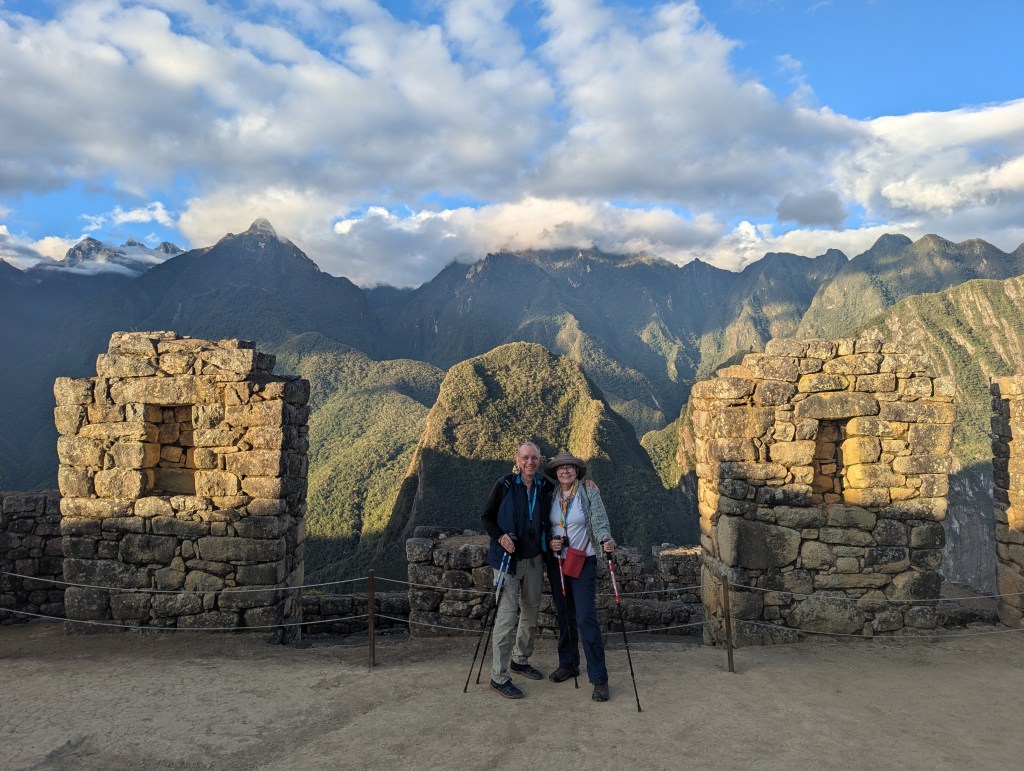
The sun goes down on Machu Picchu: winter solstice 2026. Also our 24th wedding anniversary.
The wizards of Peruvian tourism have found a way to keep the multinational hordes from crowding MP all at once: timed entry. In the base camp town of Aguas Calientes (where our hotel room was literally inches from the train tracks, and the trains ran late into the night), you queue to get on a bus that will take you uphill to the archaeological site. The queue can be long, but it moves fast. You can skip the bus altogether if you’re willing to hike up the mountain; we were not.
When you book a tour, of course, all your tickets are bought for you in advance. OAT arranges it so you can walk two of the three circuits of MP on successive days. This is, for me, the top reason to book a tour: someone else handles the logistics. We had glistening clear weather with a few fluffy clouds on both days, and if you tried really hard you could almost visualize what it might have been like in the few years of the 16th century when the citadel was twinkling with Incas.
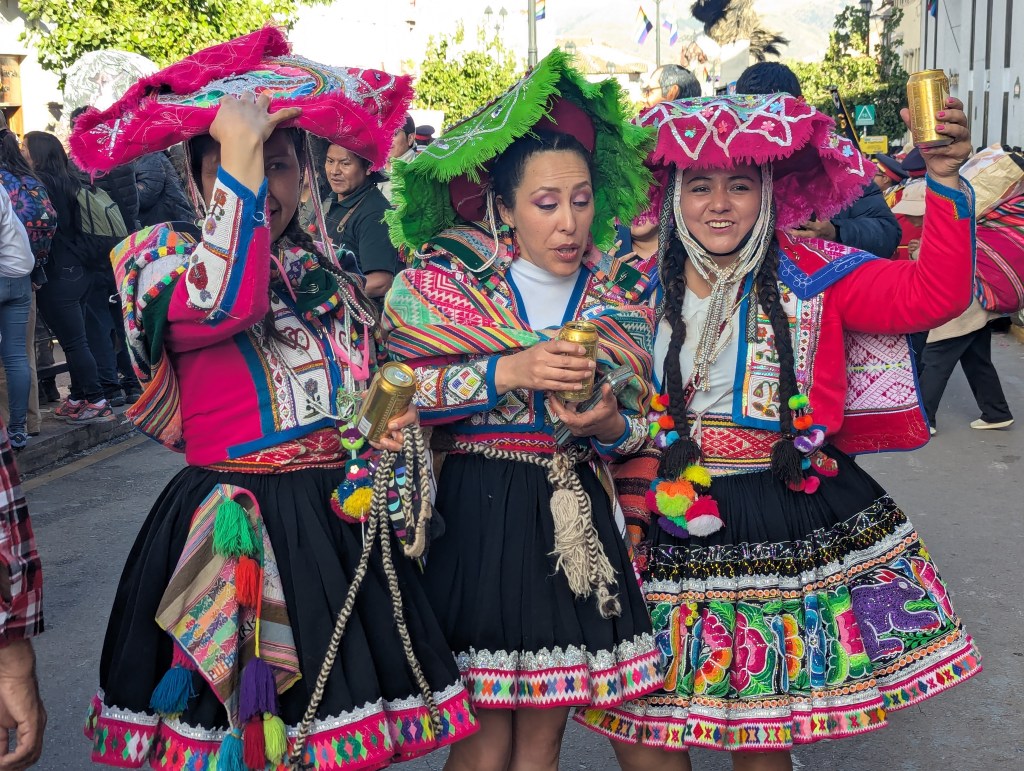
Local ladies hitting the sauce during the festival of Inti Raymi (winter solstice) in Cusco.
I came away from the trip with a deeper interest in Peru – how much history we never learned because the centuries of pre-Columbian civilization throughout the Americas were deliberately and systematically destroyed and overwritten by whitey – and mixed feelings about tours.
Bill and I like to amble, wander and mosey when we travel, and we actually don’t care how much (if anything) we “learn.” OAT made us move, wake up early, get on and off a bus several times a day, concentrate on what our tour guide told us, and eat in a large group of oldsters at restaurants we didn’t choose. A valuable exercise.
Quito’s skies are brighter and its air fresher than Lima’s, and we will not be moving to Peru. All the same, our rent has just increased by 20 percent so the apartment is even less of a deal than it was. Spending time in Peru, especially Lima, reawakened us to the reality that South America is a big continent. Not everywhere is as grubby as Quito (mostly), and we still have time to explore and consider moving elsewhere.
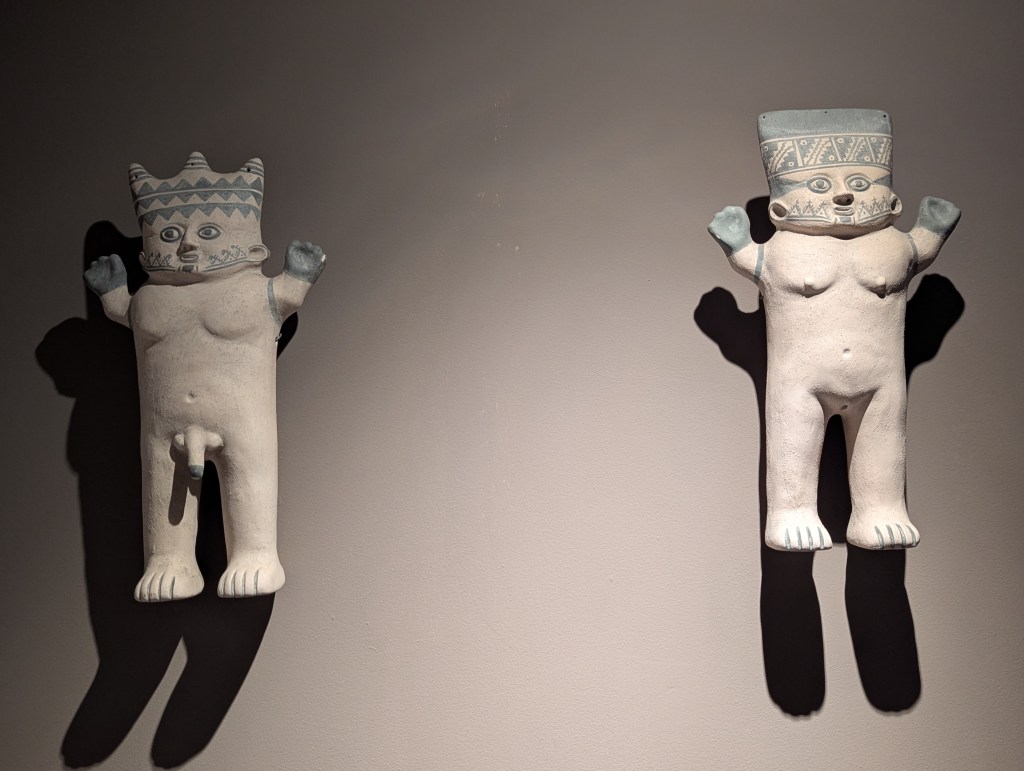
Restroom markers in Lima’s Larco Museum.


Leave a Reply